
How Light Can You Pack for a Tokyo Street Kart Tour? A Packing Guide for Repeat Visitors
How Light Can You Pack for a Tokyo Street Kart Tour? A Packing Guide for Repeat Visitors
On your last trip to Tokyo, was there anything that sat at the bottom of your backpack and never got used? A folding umbrella, a spare power bank, a jacket you packed "just in case." All that stuff was heavy, wasn't it?
Your second trip to Tokyo is different. You already have a feel for getting around the city and changing trains, so you should be able to pack a lot less too!
In this article, we'll go through what to bring on the day of your street kart tour and sort it into "bring it" and "leave it behind." Let's empty out that bag together.
How Much of Last Time's Luggage Can You Leave Behind?
Honestly, experienced travelers tend to pack more, not less. Once you've dealt with a problem on the road, you want to be ready for everything. That's completely understandable.
On kart tour day, though, it works better to flip that thinking around.
The reason is simple: during the tour, both hands are on the steering wheel. You can't hold up a camera or hitch a slipping bag back onto your shoulder. Anything you'd have to hold, or would want to rest on your lap, can come off today's list right away. That one rule cuts your packing decisions down a lot.
On a first trip to Japan, people tend to overpack because they don't know what they'll be able to buy once they arrive. It happens to a lot of visitors. But as a repeat visitor, you're past that. You've seen for yourself that drugstores and convenience stores are everywhere in the city.
In fact, there's a 7-Eleven, FamilyMart, and Lawson within a 5-minute walk of every Street Kart location. So personally, I think you can drop the idea of bringing everything from home.
I recommend leaving large suitcases and shopping bags at your hotel's front desk or cloakroom before you head out. For kart day, aim for "what fits in your pockets." Let's go with that!
The stores have lockers for small items, but they aren't meant for big luggage like suitcases. Also, none of the locations have parking. Plan to arrive by train or other public transportation, and lighten your load before you leave the hotel.
What You Can't Leave Behind: Your License Documents and Booking Confirmation
Let's stop here for a moment.
However much you cut back, there are things you can't leave behind: your driver's license documents and your booking confirmation (the email or your booking number).
Street karts are driven on public roads, so you need to be qualified to drive to join a tour. Here's where it gets tricky. The documents you need depend on the country or region where you got your license. Just because you were able to join a different activity on your last trip doesn't mean the same documents will work this time.
Don't rely on memory or what other people tell you. Before you leave, check your own situation in the official guidelines. License types and required documents are listed on the official driver's license page. Whether your license qualifies and what you need to bring on the day are both answered there.
According to the official guidelines, you need the original physical license. Digital licenses are not accepted, so a photo on your phone won't do. If you don't have the required documents on the day, you can't join the tour and you won't get a refund. Right before you leave the hotel, check your bag one more time, item by item. On days when you've packed light, it's especially easy to think you packed something you didn't.
Personally, I recommend not treating this check as part of your general trip prep. Do it at the same time you book your flights, because some documents can't be arranged in time if you only notice right before you leave.
Remember to bring your booking confirmation, and sort out your license documents early. Sticking to that order makes the day itself much more relaxed.
Knowing What's Provided Lightens Your Bag
Something that helps a lot with packing light is finding out ahead of time what will be provided.
At Street Kart, helmets and goggles are provided free of charge. On rainy days, you can borrow a raincoat for free too. If the sky looks iffy and you're not sure what to do about rain gear, remember this first.
Knowing the weather policy also makes it easier to decide whether to bring a folding umbrella. According to the official guidelines, tours go ahead as planned in light to moderate rain and are canceled in heavy rain or typhoons. If a tour is canceled, you'll be offered options such as a shorter course, a different date, or a full refund. The loaner raincoat covers you for rain while you're driving. But you'll be on foot getting to the store and exploring after the tour, so you'll need to handle rain then yourself. Check the day's forecast and whether you plan to walk around after the tour, then decide whether the umbrella stays in your bag.
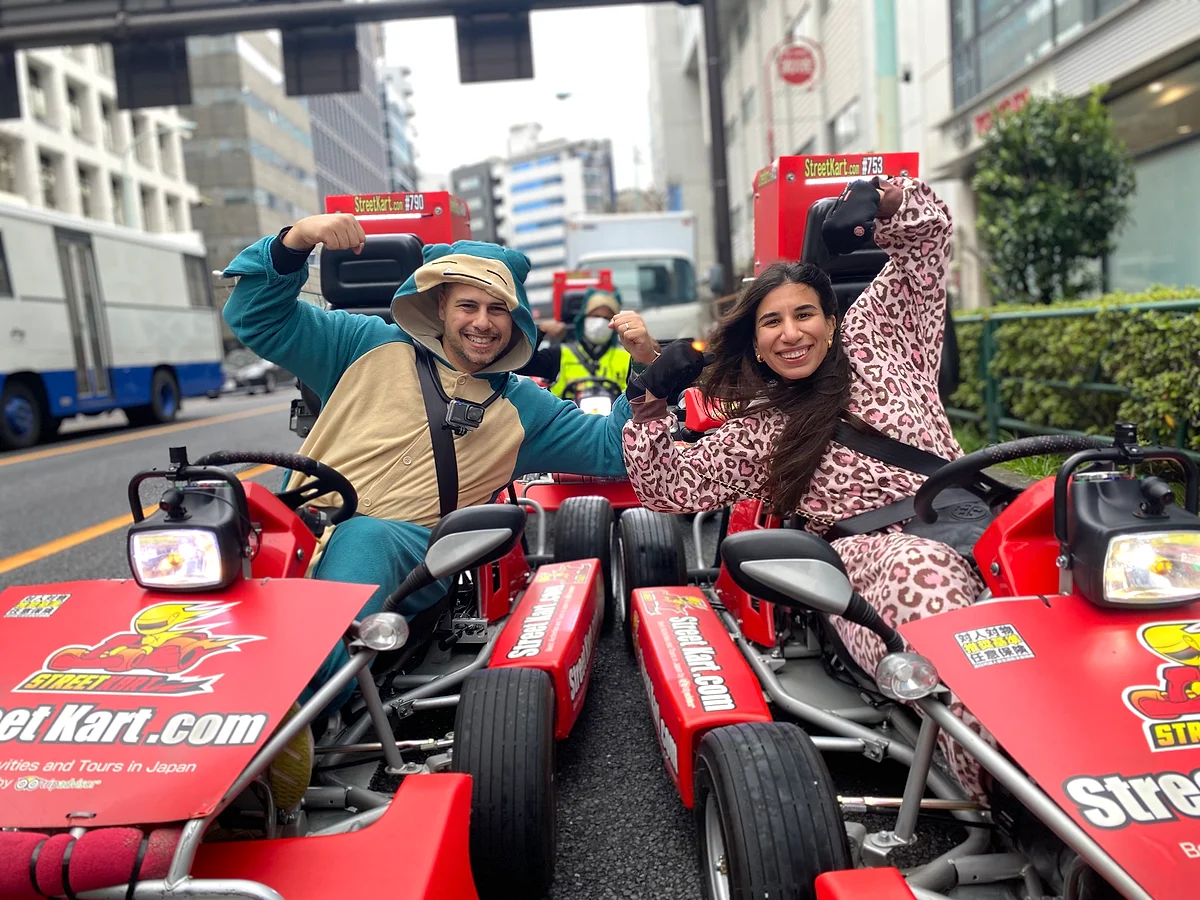
There are costumes too! You can drive in an original Street Kart costume for free, first come, first served.
This part is important, so I'll be clear about it. The costumes provided are Street Kart originals only. You choose from the costumes we provide.
Japanese has a word, "tebura" (手ぶら), which literally means "empty hands." It means heading out casually without carrying anything, and you'll often see it in information for Japanese leisure facilities. On kart day, the goal is to get as close to tebura as you can.
Choose Your Outfit Based on a Vehicle With a Very Low Seat
Now let's talk about clothes.
Unlike the things you carry, you wear your clothes all day, so you can't pick them just for the kart. The trick is finding something that works in the kart and also lets you keep walking around the city after the tour.
First, take a moment to really picture what a street kart is like.
There's no roof and no windows. The seat sits very close to the ground. Once you start moving, the wind hits you head-on. You hear the engine mixed in with the noise of the city. You're so low that a bus pulling up next to you has its tires at eye level. At red lights, you can feel the heat coming off the asphalt and the wind blowing between buildings right on your skin.
That open-air feeling is exactly what makes karting fun, and if you work backward from it, choosing your clothes gets easy.
Shoes and Hems
A low seat means bending your knees a lot every time you get in and out. Very tight pants make it hard to move, and long, flowing hems get in the way around your feet.
Wear shoes you're used to walking in that let you feel the pedals. The official guidelines ask you to wear closed-toe shoes (sneakers are recommended) and to avoid sandals and other open-toed shoes, heels, skirts, and dresses.
The same guidelines also suggest not wearing expensive clothes. You'll be in an open vehicle with the city air rushing past, so jeans or casual clothes you don't mind getting a little dirty let you relax and have fun. That outfit you saved for a nice dinner later in the trip can stay at the hotel today.
Beyond that, follow the store's or tour's guidelines for any other footwear and clothing requirements. If you're unsure, ask when you book. Don't settle for "it's probably fine." That way you won't end up scrambling to change or buy new clothes on the day.
Jackets and Accessories: Nothing That Can Blow Away or Flap Around
Since you'll be driving into the wind, leave wide-brimmed hats, long scarves, and dangling accessories behind. If something blows off while you're driving, going back for it is hard. Follow your guide's instructions while driving.
For a jacket, check the forecast and bring one layer you can throw on and close up quickly. Tokyo temperatures can vary quite a bit from day to day, even within the same month. Instead of assuming "this season means this jacket," look at the sky that morning and decide then. You'll get it wrong less often. Choose a light material that's easy to carry when you take it off, so it won't be a hassle when you explore after the tour.
In summer, the guidelines suggest sunglasses and sunscreen. If you wear a hat, choose one with a small brim that fits your head snugly.
Don't use your smartphone while driving. Keep it safely put away. You'll have plenty of time for photos before you set off or after you get back.
The official guidelines list a few things that are good to have: a camera or smartphone, a power bank, a drink, and a small bag that fits in the kart. That spare battery I said never got used at the start? If you'll be taking lots of photos, it's worth putting one in a small bag. To decide whether something stays or goes, just ask yourself whether you can picture using it that day.
Why People Choose Street Kart
If you're thinking about how much prep it takes, Street Kart has several things that cut down on both packing and research. Let's go through them one by one!
First, guides lead the tours. A trained guide drives up front, and participants follow behind on public roads. Even at Tokyo's complicated intersections, your guide is right in front of you. Personally, I find that "just follow along" feeling really helpful on a return trip.
Second, tours are generally conducted in English. Guidance in Japanese or other languages depends on the staff that day, so it can't be guaranteed. Expect your briefing to be in English.
Third, you can do your research before booking. The official website is available in 22 languages. I recommend reading the requirements and what to bring carefully in whichever language is easiest for you.
Fourth, the scenery is very different depending on the location. There are seven locations in Tokyo. However, the two Akihabara locations are right next to each other, and so are Shibuya and Shibuya ANNEX, so there are fewer distinct areas than that number suggests. Even so, the bayside with views of Rainbow Bridge and Tokyo Tower, the streets of Shibuya and Harajuku, and central Tokyo near Tokyo Station and Ginza each show you something completely different. If you want to see a different side of Tokyo than last time, picking a location is basically picking a theme for your trip. Isn't that exciting?
Fifth, as I mentioned above, helmets, goggles, raincoats on rainy days, and original costumes are all provided. Having less to bring makes the whole day feel easier.
Finally, a few numbers. As of November 2023, Street Kart had run more than 150,000 tours across all locations and served more than 1.34 million customers, with an average rating of 4.9 out of 5. These figures are from that time, so keep that in mind.
After the Tour, Explore the Area Hands-Free
Packing light makes the time after your tour much easier to enjoy. Here are some places you can walk to before or after the experience.
Around the Shibuya and Shibuya ANNEX locations, Shibuya Scramble Crossing is a 10-minute walk, and Takeshita Street and Omotesando are about 15 minutes away. Some courses even drive through this area. Take a second look on foot at the streets you just raced through. The signs and storefronts that flashed past a moment ago look completely different at walking speed.
From the Shinagawa location, Shinagawa Shrine is a 5-minute walk. There's a torii gate at the top of a stone stairway, along with a Fujizuka, a miniature mound modeled on Mount Fuji. If you're up for a longer walk, Tennozu Isle, with galleries and cafés along the canals, is 20 minutes away.
The Tokyo Bay location (Shin-Kiba) is an 8-minute walk from Shin-Kiba Station. The station has a café and restaurant called CASICA, a good place to unwind after your tour.
From around the Akihabara locations, Kanda Myojin Shrine is about a 10-minute walk. You go from a flood of Electric Town signs to the quiet of the shrine grounds, and that contrast is wonderful.
Wherever you end up, if all you've got is a jacket and what's in your pockets, you can head straight to your next plan. You might actually notice the benefits of packing light most after the tour is over.
Cut the Last of Your Prep Work With Booking and Questions in Advance
Finally, let's sort out booking. Street Kart takes reservations through Facebook, LINE, and email. You can find contact details on the official website. If you have questions about your license or what to wear, ask them when you book so you won't be scrambling on the day.
Weekends fill up fast, so if your dates are set, book early. Decide which day of your stay will be kart day first. Then you can easily pick that day's outfit and what to leave at the hotel the night before.
If your plans change after booking, you can cancel for free up to 7 days before. On the day, arrive at the store at least 15 minutes early for check-in and the safety briefing. With less to carry, you can check in quickly and focus on the briefing. If your route has a lot of transfers, use what you learned about the stations on your last trip and leave with some time to spare.
Put real effort into your license documents early. For everything else, go as close to empty-handed as you dare.
On your second trip to Tokyo, that's just the right amount of light!
Come with just one pocket's worth of stuff. And once you grab the wheel, let the city wind hit you head-on. We'll be waiting for you!
This article was originally written in Japanese and translated using AI. Some expressions may read unnaturally, and we appreciate your understanding. For the most accurate and up-to-date information, please refer to the official site at kart.st.
Street Kart is not affiliated with Nintendo or the Mario Kart series in any way. We do not provide costumes of Nintendo characters, and such costumes may not be worn during tours even if brought by participants.