
A Second Street Kart Ride Through Tokyo in Autumn: After the Landmarks, Look at the Color of the Streets
A Second Street Kart Ride Through Tokyo in Autumn: After the Landmarks, Look at the Color of the Streets
Think back to your last tour. The Shibuya Scramble Crossing, the Rainbow Bridge, the signs of Akihabara. You can still picture those big sights clearly, right? So what color were the trees along the road?
...You probably can't remember.
That's completely normal! The first day you take the wheel, you're busy following the guide in front of you and watching the traffic lights. You didn't so much "see" the scenery as "pass through" it. So on your second ride, why not ask for a little more? Late autumn in Tokyo, when the city slowly changes color, is a good time to go back and look at the "color of the streets" you missed last time.
On Your Second Tokyo Ride, Watch the Trees Instead of the Landmarks
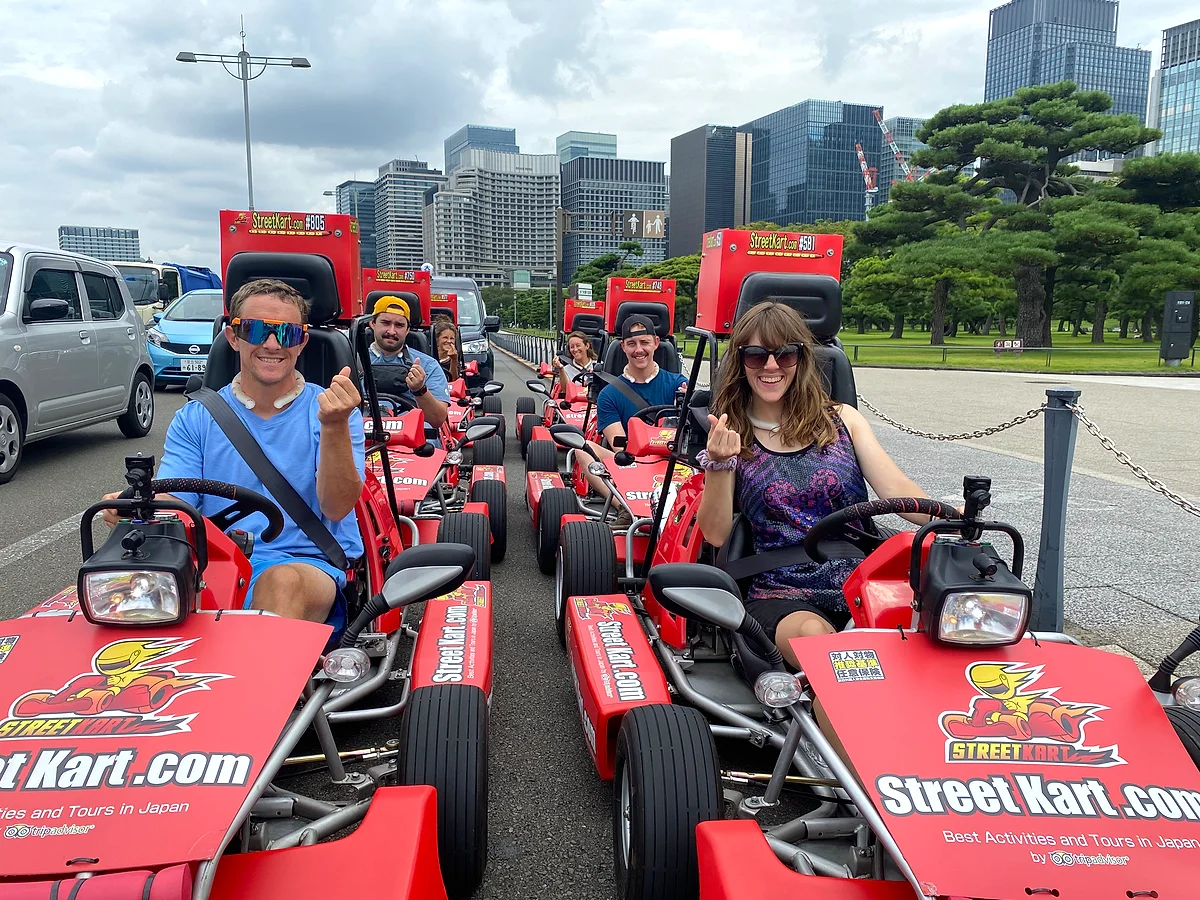
If you've done Street Kart before, you probably remember how it felt. No roof, a low seat. The wind hits you right in the face, and the engines in the next lane and the city noise bouncing off the buildings rush past just beside you. On your first ride, that feeling was the whole experience.
On your second ride, you already know that feeling. This is the important part!
Because you're used to it, you have time to look a bit higher and a bit further to the side. And in late autumn, what you'll find up there and off to the side has changed. The street trees turn color, fallen leaves pile up along the sidewalks, and the sky showing between the branches gets a little wider each day. If you rode in summer or spring, it may feel like a different place, even on the same roads.
There's one thing you need to update from your last ride, though. Tokyo gets colder than you'd expect once you're moving this time of year. With the seat that low, you take the full force of the cold air coming up off the pavement and the wind blowing between the buildings. This goes double if your last ride was in summer. Show up in light clothes expecting the same breezy fun, and within the first few minutes all you'll be thinking is "It's freezing!" Dress to keep your neck and hands warm, and you'll have attention left over for the scenery.
In the US, fall foliage usually means driving out to the mountains or a state park. In Japan, and in Tokyo especially, autumn color is right in the city too. Tree-lined avenues, the woods around shrines, the edges of parks. Bright yellow and red appear out of nowhere at the foot of tall buildings. I've lived in Japan for five years, and this combination still surprises me. From the low seat of a kart, you notice the tree trunks and leaves before the buildings. It's exactly the right height for seeing autumn in the city.
The peak foliage season moves a little from year to year, and the timing varies from place to place even within Tokyo. There's no date that guarantees the trees will be bright red. Honestly, I think the best time is when trees that are still green stand on the same street as trees already dropping their leaves. When you drive past, they blend into one long, flowing gradient.
A Different Store Shows You a Different Autumn
There's one tip I always give foreign friends for their second ride: pick a different store from last time. Tokyo has stores in Shibuya, Shinagawa, Tokyo Bay (Shinkiba), and Akihabara. The autumn scenery you see changes completely depending on where you start!
Shibuya and Shibuya Annex are in roughly the same area, and so are Akihabara No. 1 and No. 2. For details on each store's courses, check the official website (kart.st).
Shibuya and Shibuya Annex: The Zelkova Trees of Omotesando and the Edge of the Forest
Now let me contradict myself. If your last ride was in Shibuya, choosing Shibuya again is a real option, and the reason is Omotesando. That goes double if the designer shops on Omotesando caught your eye last time.
The real star of Omotesando isn't the buildings, though. It's the rows of Japanese zelkova trees that line both sides of the avenue for its whole length.
Let me tell you a little about these trees. In summer, they form a tunnel of deep green. By late autumn, the leaves shift from yellow to a brownish orange. From the low seat of a kart, the trunks are what you notice first. One thick trunk after another seems to come toward you. Look up, and the branches reach out from both sides of the street until they almost meet overhead. Walking on the sidewalk, you never notice how deep the rows go, but on a kart you feel it with your whole body. Colored leaves are suddenly reflected in the glass of the unusual buildings designed by famous architects. Drive through this season and you'll catch moments like that.
The Omotesando zelkova trees are also a well-known spot for photographing the illuminations around Christmas. Lights on bare branches look nothing like a canopy of autumn leaves overhead. See the trees once in autumn and again when the lights are up. Comparing the same avenue in different seasons is something only a returning rider gets to do.
The Shibuya course also passes near Meiji Jingu and Yoshinogi Park. Both are large green spaces in the middle of the city, and from the road you only see the "edge" of the forest. Even so, when a wall of trees suddenly appears in the middle of all those buildings, you'll probably feel the air smell a little different.
If you have time after the tour, take a walk through Meiji Jingu (20 minutes on foot from the store) or Yoyogi Park (also 20 minutes on foot). First you see only the edge of the forest from the kart, then you walk into it on your own two feet. That order is what makes it work! It feels like going back on foot to see the rest of what you saw from the kart.
Shinagawa Store: Takanawa's Temples and Shrines, and the Bayfront Sky
Around the Shinagawa store, you'll see the business district near Shinagawa Station, the Takanawa area, and the bayfront around Shibaura and Tamachi. Takanawa is dotted with historic temples and embassies, and it's also home to Sengakuji, where the graves of the 47 Ronin of Ako are. Temple trees peek out between the buildings. It's a different side of autumn from the avenues of Shibuya.
Once you reach the bay, the sky takes over from the trees as the main view. On clear autumn days, you can sometimes see the outlines of the Rainbow Bridge and Tokyo Tower in the distance in sharp detail. The wide bayfront roads, swept by a cold sea breeze, are where you really feel late autumn on your skin.
If you want to walk before or after the tour, try Shinagawa Shrine, 5 minutes on foot from the store. At the top of the stone steps is a Fujizuka, a small hill built to look like Mount Fuji. It's a good place to catch your breath and look at the turning trees on the grounds. Also stop by Honsenji Temple, 10 minutes on foot from the store. The temple is over 1,200 years old and has one of the Six Jizo of Edo, plus a great temple bell designated a Tangible Cultural Property of Tokyo. Go a little further to Sengakuji (20 minutes on foot) and you can see the Takanawa temple area you saw from the kart, this time from the inside. Or head to a café in canal-side Tennozu Isle (20 minutes on foot) and warm up your cold hands.
Tokyo Bay Store: The Rainbow Bridge, and Tokyo Tower Near Shiba Park
If you crossed the Rainbow Bridge from the Tokyo Bay store last time, I want you to focus on something other than the bridge this time: the moment Tokyo Tower comes closer. Look up at Tokyo Tower from near Shiba Park, and you'll see the park's trees spreading out at the foot of the red-and-white steel tower.
On your first ride, you may have been shouting "It's Tokyo Tower!" and staring only at the top. In late autumn, lower your gaze just a little. The red of the 333-meter tower and the yellow and orange of the trees at its base fit into the same view. A steel tower that symbolizes the Showa era, and trees that change color every year without fail. You only get to see the two together if you pick the right season.
Late autumn is also when the sun sets early. Some Tokyo Bay store courses run in the evening, so you can enjoy the night view. The 798-meter Rainbow Bridge is lit up in seven colors at night. If you rode during the day last time, just seeing the bridge you crossed turned into a ribbon of light should be reason enough to come back. But once the sun goes down, the bay wind gets even colder. Check the official website (kart.st) to see whether evening slots are offered and what's available.
There's little to block the wind on the bayfront, so if you choose this store, dress especially warmly. If you have time after the tour, head to Kasai Rinkai Park (15 minutes by car from the store) and walk around its large grounds by the sea.
Akihabara No. 1 and No. 2: Around Ochanomizu and Kanda Myojin, and Red Brick
Akihabara means the signs of Electric Town. If you enjoyed that busy, exactly-as-advertised scenery last time, that's one side of Akihabara. But the area around Akihabara also has a surprisingly calm side.
One is the area around Ochanomizu, a student neighborhood full of universities and home to Nikolai-do, an Orthodox cathedral. The other is the area around Kanda Myojin, the 1,300-year-old "guardian of Edo." Move just a little away from the neon, and the streets turn to stone and wood. The red-brick Marunouchi Building of Tokyo Station and the Wako clock tower in Ginza might show different shadows in the low autumn sun than they did last time.
The Marunouchi Building of Tokyo Station is a red-brick building that opened in 1914 (Taisho 3) and finished restoration in 2012. In the slanting sun of an autumn afternoon, the red of the brick can look even deeper. If you've just seen yellow trees in Omotesando or Shiba Park, this red brick might look like another autumn color.
Before or after the tour, I recommend visiting Kanda Myojin (10 minutes on foot from the store). Step onto the shrine grounds, and the sounds of Electric Town, which should be right nearby, quietly fade away. If you want to walk among more trees, go a little further to Ueno Park (5 minutes by train) or the East Gardens of the Imperial Palace (25 minutes on foot). First you race past Electric Town and red brick in a kart, then you walk slowly through the trees. That change of pace feels wonderful.
Seeing What Makes Street Kart Great, With Second-Timer Eyes
On your first ride, "I actually drove it!" is often all you can think about. By the second time, you start to see which parts of the service actually suited you. Let's look back at them.
First, a guide leads the way. On every tour, a trained guide drives at the front. Even on your second ride, you'll still be driving unfamiliar roads from an unfamiliar store. Some of you will remember following that guide last time.
Next, there's a plan for the weather. In light to moderate rain, raincoats are provided for free. And the sight of wet pavement after the rain, with fallen leaves stuck to it reflecting streetlights and traffic signals, is hard to forget in its own way. In heavy rain or a typhoon, however, the tour is canceled. In that case, you can choose a shortened tour (with the difference refunded), a different date, or cancellation with a full refund.
Once you've decided which store you want, it's time to book and get ready.
Booking and Preparing for Late Autumn: What to Do Differently This Time
Weekends fill up fast, so book early. Reservations are accepted via Facebook, LINE, and email (booking@streetkart.com). Prices vary by season and time of day, so check the official website (kart.st) for current prices. Cancellation is free up to 7 days in advance. For full conditions, check the official website (kart.st).
On the day of the tour, guidance is generally given in English. Guidance in Japanese or other languages depends on the staff that day and isn't guaranteed. The website is available in 22 languages. If you have questions about languages other than English, contact them through the official website in advance.
One more thing second-timers often overlook: checking your driver's license. Just because you could drive last time doesn't mean you can this time! Before you go, double-check that your license or International Driving Permit hasn't expired. The required license types and what to bring are listed on the official website's driver's license page. See the official website for details.
Unlike last time, layering is key for what to wear. While you're driving, the wind makes it feel colder, but walking around shrines and parks before or after warms you up. Wear clothes that are easy to take off and put back on. Just having gloves and a neck warmer makes a big difference in how much attention you have for the scenery.
For shoes, sneakers with closed toes are best. Avoid heels, open-toed shoes, skirts, and dresses. If you're layering, you may wonder where to put the jacket you take off or your other bags. The stores have lockers for small items, but they won't fit large luggage like suitcases. Bring as little as possible and pack it into a small bag that fits on the kart.
Finally, a few words about photos. Whether it's the zelkova trees or the trees at the foot of Tokyo Tower, don't hold up your phone while driving. Look with your own eyes. Taking your hands off the wheel is dangerous. If there's a view you want to shoot, take it at the photo spots where the guide stops, or walk back to shoot it before or after the tour. Burn the view into your memory from the kart, then walk back and capture it in a photo. That's another thing only a second ride gives you.
If your first Street Kart ride was about "driving through Tokyo," your second can be about "seeing Tokyo's seasons."
A different store, a different season. The same Tokyo flows past you in completely different colors. Go see for yourself what it's like to pass under the yellow zelkova trees from that low seat. Weekend slots fill up fast, so once you've picked a store, start by asking about availability. Here's to your second ride through Tokyo!
This article was originally written in Japanese and translated using AI. Some expressions may read unnaturally, and we appreciate your understanding. For the most accurate and up-to-date information, please refer to the official site at kart.st.
Street Kart is not affiliated with Nintendo or the Mario Kart series in any way. We do not provide costumes of Nintendo characters, and such costumes may not be worn during tours even if brought by participants.